


I. What a framework can build
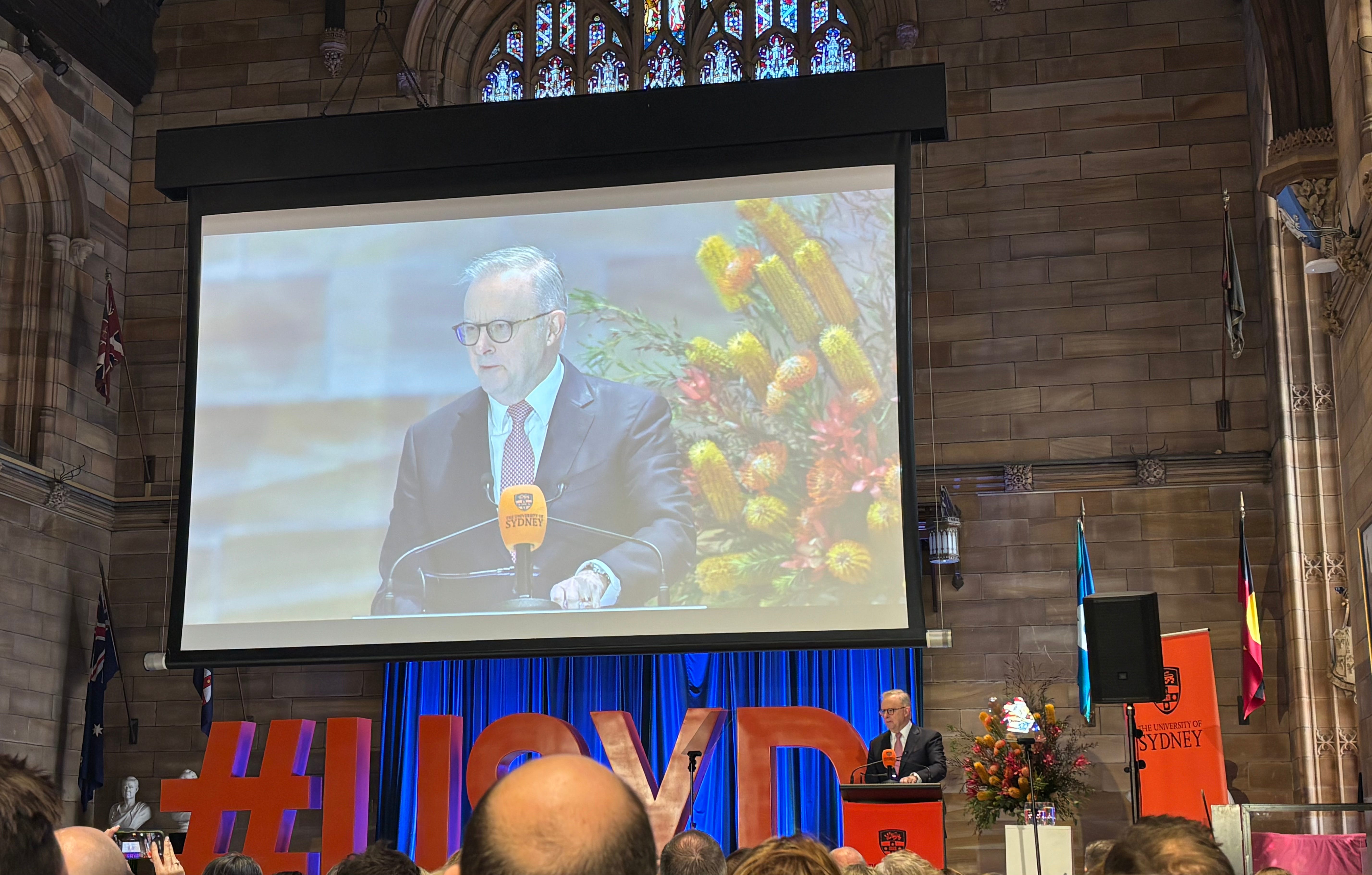
Last Wednesday I sat in the Great Hall at the University of Sydney. Under stained glass and soaring ceilings, listening to our Prime Minister launch what he called
“AI in Australia’s interests.”
I leaned forward as he spoke of attracting global capital to our fair shores because AI investors would know the rules, because we would be the first nation with national standards. A worthy aspiration, despite my natural disposition towards small government.
Somewhere in the middle, he recounted his first job: a teenager at a CommBank branch, on campus persuading customers to abandon their passbooks and trust a strange new contraption called an ATM. His KPI - convert 20%.
In my previous essay, I argued that Australia’s sovereignty debate is missing its fourth category. We defend the hardware layers (minerals, energy, data centres) but leave undefended the point where all of it finally meets its purpose: the moment a citizen opens the model and starts to think alongside it.
Cognitive sovereignty, I called it: the capacity to do your own thinking when a frictionless alternative sits one tap away. A reader, Peter Ashby Smith, sharpened it further: a nation that owns its infrastructure but steadily loses its citizens’ capacity for judgement is still becoming dependent - just more subtly.

The Prime Minister’s framework, to its credit, gets close. There were fences and locks for children - duty of care, chatbot risks. But protection is not formation. A framework can govern where intelligence is made and who it’s allowed to reach. It cannot build the person who has to face it.
Forty years after that teenager sold the ATM, the machine has changed and the question hasn’t: who can actually hold their own thinking when it arrives? The answer is more uncomfortable than anything announced from that stage.
II. What it can’t build
Start with who can’t - because that’s the question the research answers first, and the answer runs backwards.
The more you understand how AI works, the less willing you are to hand it your thinking. Lower AI literacy predicts greater receptivity, not less (Tully, Longoni & Appel, 2025) and the less you understand the machine, the more magical it feels. Which means the machine’s most enthusiastic users are, on average, its least qualified judges. The people best equipped to challenge it are the most reluctant to defer; the people least equipped are the most eager.
Sit that next to the intuitive story - that smart people gravitate to AI and it makes them smarter still - and it falls apart at both ends. Adoption doesn’t track understanding. And on outcomes, the landmark Harvard–BCG experiment with 758 consultants found AI worked mainly as an equaliser: the bottom half of performers improved by 43 per cent, the top by 17 (Dell’Acqua et al., 2023). AI lifts floors far more than it raises ceilings.
Which raises the question the whole discourse keeps stepping around. If the ceiling barely moves, what is the ceiling made of? What does the person at the top have that the machine can’t hand up to the person at the bottom?
Arvind Narayanan built his recent ICML keynote around the same distinction - the floor is what AI can do on its own; the ceiling is what AI lets you do, and “the ceiling is not going up automatically.”
The ceiling, in other words, has to be built by hand. I think it’s made of two dispositions - neither of them intelligence, neither installable in a workshop.
The first disposition: wanting to think
Psychologists have a measure called need for cognition - the extent to which a person enjoys effortful thinking for its own sake (Cacioppo & Petty, 1982). It is one of the most reliable predictors in the AI-reliance literature: people high in it use AI less reflexively, scrutinise its outputs more, and are far less likely to defer when the machine is wrong. People who love to think don’t outsource it, because handing over the interesting part would defeat the purpose.
Over years, that appetite compounds into something more valuable than any single insight: craft. This is what motivation, persistence and process produce when they’re pointed at one domain for long enough. The sommelier who has tasted ten thousand wines doesn’t analyse the label to know something is wrong with the glass; the deal-maker feels the clause that doesn’t belong before they can say why. That kind of knowing was built by doing the work, making the errors, and staying in the game long enough for pattern recognition to become instinct. It cannot be shortcut.
This is the uncomfortable part: passive use attacks this disposition at the root. In a randomised study published this year, a short stretch of AI assistance left people performing worse once the tool was removed.
They still had skill but they’d lost the persistence. They gave up faster (Liu et al., 2026).
Persistence is one of the raw materials of craft. Use the machine passively and it doesn’t just fail to build your ceiling; it quietly eats the thing your ceiling was made of.
The second disposition: willingness to be changed
The first disposition explains who builds expertise. It doesn’t explain who stays honest about it - and that’s where the second ingredient comes in.
My argument is you also need aptitude for change: the capacity to hold your beliefs lightly, to stay open when your position is challenged, and to overcome what Robert Kegan and Lisa Lahey called our immunity to change. Hidden commitments that make us defend a self-image even when it’s costing us (Kegan & Lahey, 2009).
In two decades of transformation work, this is the trait I’ve watched decide outcomes more often than talent has.
What this disposition produces, in a person who has it, is calibrated doubt. Not the crippling kind - the productive kind, where you never fully trust your own first draft or anyone else’s. It’s the temperament behind an old observation about writing: the best writers hate their own sentences and the worst love them.
The internal critic that makes producing work painful is the same faculty that makes you a good editor of a machine’s output. You cannot be fooled by fluency if you never trusted fluency in the first place.
Now put the two dispositions against the machine. The most dangerous user is the one who reads a fluent output and thinks yes, that’s what I meant. The safest reads the same output and thinks that sounds too clean, what did it flatten?
The difference between them isn’t training. It’s who they’d already become. Certainty in the craft, openness in the judgement - certain hands, questioning mind.
A four-box test of the point
Jon Whittle, director at CSIRO’s Data61, published a useful piece last week offering four modes of AI use - Surrender, Verify, Partner, Reject. He aims for Partnering: bringing your own thinking and arguing with the framing.
But notice what that requires? Bringing your own ideas first requires having built some - that’s the first disposition. Challenging the framing rather than the facts requires being comfortable having your own framing challenged back - that’s the second.
Which brings me to what I think AI actually is, for the person using it. The marketing says ladder: a tool that lifts you to capabilities you don’t have. The evidence says mirror: a system that reflects and amplifies whoever showed up.
Bring motivation and craft, and it sharpens you - you argue with it, you catch its flattening, you leave the session with your thinking stress-tested. Bring neither, and it obligingly reflects that too: fluent, agreeable, and steadily absorbing the effort you used to spend becoming someone.
The equaliser finding isn’t AI generosity. It’s the mirror giving the bottom half a reflection of competence - while the persistence data tells us what that borrowed reflection costs.
Three warnings, one month
Then, in the space of a month, three of the most credible voices on the planet published warnings about AI use - and each aimed at a different failure.
David Brooks, in The Atlantic, warned about passive use: accept the machine’s output and it hollows you out, while the people who wrestle with it (correct it, challenge it, refuse its first draft) keep their capabilities intact. Use it lazily and you lose yourself.
Satya Nadella warned about skilled use, arguing that the buyer of intelligence pays twice - once with money, and again with the proprietary knowledge they must reveal to make it useful. The leak isn’t your data, it’s your corrections. Every that’s wrong, and here’s why is an act of judgment, captured trace by trace. The more expert the wrestling, the richer the extraction. Use it well and you are, simultaneously, priced.
And Arvind Narayanan warned about premature use: reach for the machine before you’ve mastered the task and you fall into what he calls the dependence spiral - losing what little skill you had. His rule is sequence. Master first; amplify second.
Put the three together and they aren’t a debate. They’re a map of the same act from three sides: wrestle, after mastery, knowing the price. The dispositions are what let you follow it - wanting to think gets you through mastery when the shortcut is one prompt away; willingness to be changed keeps the mastery honest once the machine starts agreeing with you.
Back to the Great Hall
I keep coming back to one line in my notebook, summarising how I felt about the PM’s speech:
national success will belong to whoever builds the most capable institutions and the most capable citizens.
A national framework answers the first half. But nobody is yet writing the second, because there is no Office of AI for the mind.
You cannot choose, on a Tuesday morning, to be the person the mirror rewards.
But you can start building that person - a domain worked long enough to grow taste, beliefs held lightly enough to survive being wrong, the discipline to earn the craft before you hand it a megaphone.
The machine will meet you exactly where you are. The work is to be further along when it does.
References
Brooks, D. (2026, June 28). The people who will thrive in the AI age. The Atlantic.
Cacioppo, J. T., & Petty, R. E. (1982). The need for cognition. Journal of Personality and Social Psychology, 42(1), 116–131.
Dell’Acqua, F., et al. (2023). Navigating the jagged technological frontier. Harvard Business School Working Paper 24-013.
Kegan, R., & Lahey, L. L. (2009). Immunity to change: How to overcome it and unlock the potential in yourself and your organization. Harvard Business Press.
Liu, G., Christian, B., Dumbalska, T., Bakker, M. A., & Dubey, R. (2026). AI assistance reduces persistence and hurts independent performance. arXiv:2604.04721.
Nadella, S. (2026, July 12). The reverse information paradox. sn scratchpad.
Narayanan, A. (2026, July 9). What will be left for us to work on? Keynote, International Conference on Machine Learning, Seoul. Annotated slides via AI as Normal Technology.
Tully, S., Longoni, C., & Appel, G. (2025). Lower artificial intelligence literacy predicts greater AI receptivity. Journal of Marketing, 89(5).
Whittle, J. (2026, July 7). What does responsible AI really mean? Being Human in an AI World (Substack).


Thanks for weaving me into this, Ashton.
The idea that resonated most was the title. There really is no Office of AI for the Mind.
No regulator can build wisdom.
No policy can cultivate judgement.
No technology can outsource character.
Those remain profoundly human responsibilities.