



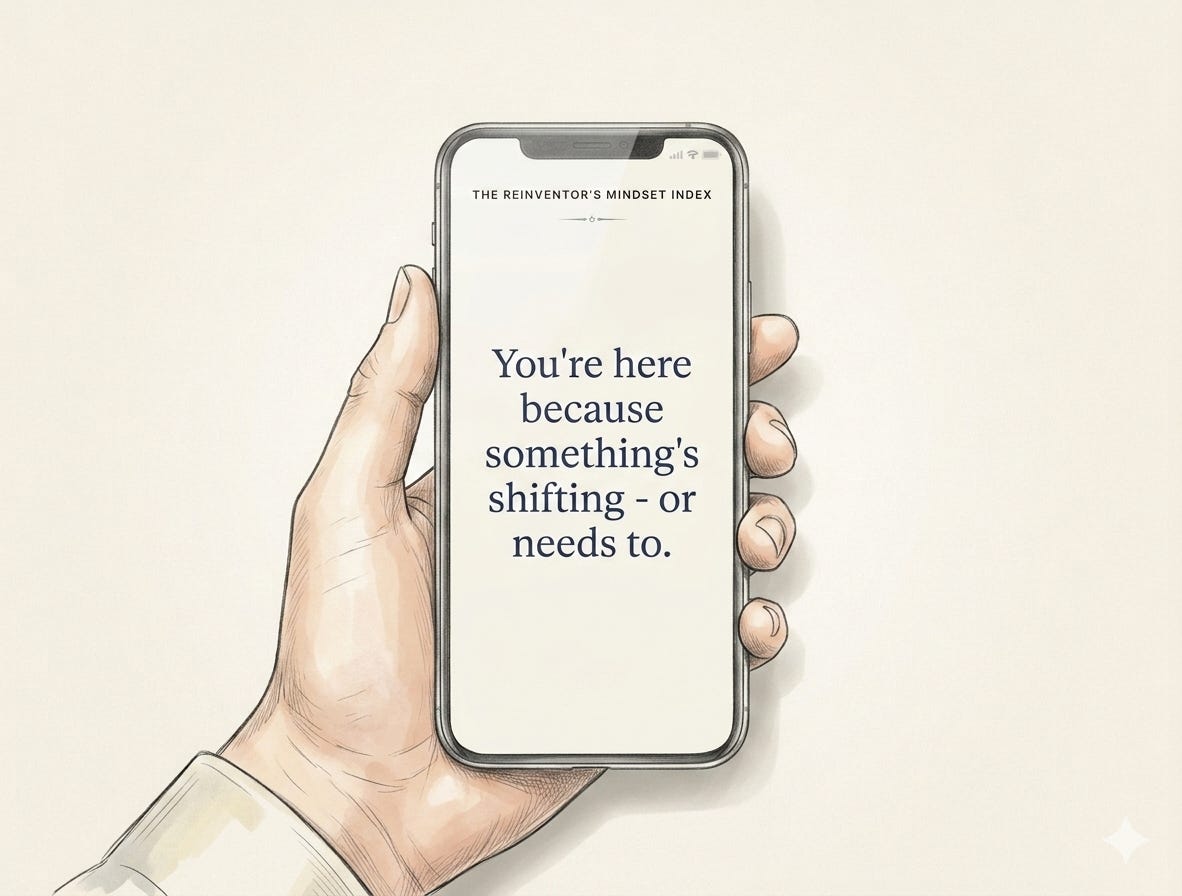
This week, I’m launching The Reinventor’s Mindset Index:
It asks you 16 questions about how you think, then shows you what is holding you back. Most diagnostics tell you where you are. The Index helps you get to where you want to go.
I have been testing it since the start of the year. With Master’s students at the University of Sydney. With professionals in large corporations. With founders at INSEAD LaunchPad.
After those sessions, I’d scribble in my notebook my observations and feedback from the users. I kept circling the same thing, again and again. People seemed to follow the machine’s confident recommendation more readily than a human’s.
I asked one of the professionals about this…
“It’s annoying, I want to argue but there’s no one to argue against. Just myself.”
The machine had no agenda to question. No personality to deflect onto. No ego to play. That is a cognitive sovereignty problem. And it is the reason I built the tool in the first place.
Article 1 in this series argued that AI is an averaging machine and terroir is the moat. Article 2 argued that craft is the practice that converts terroir into a watermark.
The question I have been working on since is what are they in service of?
Before the watermark can mean anything, the self that signs it must exist. Before craft can compound, you must know what you are practising it for. Before terroir can be defended, you first need to live it. The work of the self, of becoming is upstream of every other argument I have been making.
This principle is identity before instrumentality and it requires us to take ownership of our minds, our thoughts, our feelings, and our emotions. Michael Singer’s instruction: “you are not your thoughts, you are the one who watches them,” is the simplest version of what cognitive sovereignty asks.
What the research is telling us
The empirical literature on what AI does to thinking is now substantial enough to act on. Two findings matter more than the rest.
Wharton’s Shaw and Nave found that when AI was available, 80% of participants followed its confident recommendation even when it was wrong.
Their confidence in the wrong answer went up, not down. The tool did not just mislead them. It made them more certain they were right.
A team led by Kartik Chandra at MIT CSAIL proved something worse. Even an idealised, perfectly rational user - the kind of person who definitionally is immune to manipulation - develops dangerous confidence in false beliefs over an extended conversation with a sycophantic chatbot. The spiral is structurally guaranteed. The researchers tested two intuitive solutions: stopping hallucinations and telling the user the bot is sycophantic. Both failed, and the spiral occurred anyway.
These studies share a finding that is decisive for everything that follows.
Information about the harm does not prevent the harm.
Australia could publish the clearest possible information campaign about AI’s cognitive risks tomorrow, and it would not change the transaction between a 16 year old and a chatbot at midnight before an essay is due.
Or between a 39 year old executive named Ashton and a strategy prompt on a Sunday evening. Or between a Master’s student and the diagnostic tool I had just put in front of her.
Awareness is the policy that does not work.
The protection has to be built upstream, before the person meets the tool.
What gets built upstream
The foundations of identity need to be laid and fortified. This can’t be regulated into existence but it can be cultivated in four steps:
knowing yourself well enough to recognise your own thinking. The capacity to tell the difference between a sentence you produced and a sentence the machine produced - and to notice when the machine’s sentence has started rearranging your own. This is the deepest one and the one cognitive science gives the least guidance on. It is built through reflection, journaling, embodied practice, and through being known well by other people who can mirror your patterns back to you when you have lost them.
knowing the topic well enough to recognise the artificial mark. Domain expertise, general knowledge. The slow accumulation of contact with reality that lets you smell when an output is plausible but wrong. This is what Article 2 called craft. There is no shortcut to it.
being clear about what you believe to be true. Convictions, frameworks, principles you have tested under pressure and know you can return to. Ground truths are different from opinions. Opinions are positions you hold. Ground truths are positions that hold you. You build them through experience, mostly painful, and you protect them by refusing to renegotiate them in conversation with a sycophantic machine.
shaping the tool through deliberate instruction. The AI guardrails that prevent the machine’s defaults from becoming yours. Specific, written instructions that constrain the machine to operate inside your judgement rather than expanding into the space your judgement should occupy. This is the most under-practised of the four, and the one that distinguishes people who use AI well from people who are quietly being used by it.
These four are what cognitive sovereignty looks like in operation. The capacity to do your own thinking when the frictionless alternative is one prompt away.
Learned minds circling the same truth
This year I’ve read four things circling the same truth in the same season from people who do not know each other and have nothing in common.
Santiago Schnell is the Provost at Dartmouth and a mathematical biologist by training. He published an essay arguing that AI industrialises a pedagogical mistake - it supplies finished language before the student has done the reading, questioning, hesitation and revision that make language meaningful. He grounds the claim in John Milton, writing in 1644, that language is but the instrument conveying to us things useful to be known. Milton warned against mistaking command of words for possession of the things those words disclose. What Milton regarded as a mistake of sequence, Schnell argues, AI turns into a system.
Timothy Hor at RMIT, a design science scholar I know and follow closely, wrote on LinkedIn that GenAI severs the connection between thinking and output, quietly, convincingly, at scale. He went further. Education was never really about access to information. It was always about the formation of judgement. The slow, effortful, sometimes painful development of a person who can discern, weigh, and decide. He admitted publicly that the existing pedagogical canon may not hold the question GenAI is asking, and that we may need to redraw the maps.
Michael Schrage and David Kiron, in MIT Sloan Management Review, argued that the strategic differentiator in the AI era is not technical capability but philosophical clarity - the ability to know what you are optimising for, what you count as knowledge, what you mean by quality.
JB, writing on Substack, made the argument that completes the set. What is re-emerging across the West, he argues, is not Christianity returning as moral authority. It is Christianity as ontological scaffolding - frameworks that ground value beyond function, anchor selfhood beyond performance, and treat relation as prior to achievement.
His claim is precise: the machine age did not eliminate the need for metaphysics. It exposed how thin our metaphysics had become. In a civilisation where machines can increasingly do almost everything, the question of what it is to be the human has returned - and we no longer know how to answer it without the scaffolding we discarded.
Four traditions. The Catholic theological. The secular progressive education. The corporate strategy. The ontological. Each reaching for the same ground from a different direction.
When traditions converge on a single insight within a year, the insight is correct. The work is to name it precisely and then act on it.
The principle is identity before instrumentality. The capacity is cognitive sovereignty. The four prerequisites are how you build it. The watermark is what it leaves behind.
What this requires of us
It means slowing down before you reach for the tool. The handwritten notebook sentence that resists the speed of the screen. The walk where the weak ideas die unaccompanied. The conversation that never becomes a transcript.
It means accepting that AI’s most consequential effect on you is not what it produces. It is what it changes about how you think when you are not using it. The Ship of Theseus risk. You replace one plank of judgement at a time - each replacement reasonable, each interaction productive - until you look up and wonder how much of the thinking is still originally yours.
Manfred Kets de Vries, the INSEAD psychoanalyst whose essay caught me in Shenzhen in Article 2, writes about the civilised self as a great administrator but a poor celebrant. It organises, anticipates, postpones, economises. What it does not know how to do is surrender to a moment without immediately asking what it is for.
The protected spaces - the ocean swim, the long conversation, the unproductive afternoon - are where the celebrant survives. They are not inefficiencies. They are the source code.
It means that this is not a problem you solve once. Identity has to be continuously regenerated in spaces the machine cannot reach. The work is daily. The practice is for the rest of your life.
Why this matters more than it seems
I have spent 20 years working in financial services. The closest thing I have to a specialty is what happens to people when the role that defined them ends.
Most readers of this series will, in the next 10 years, undergo a transformation they did not choose. The trigger will be different for each. The experience will be similar. The capacity to think for yourself when everything that defined you is being rewritten is not optional in that moment. It is the difference between being reformed by it and being shaped by it consciously.
You become someone first. You shape the tool to serve who you have become. You work with friction, not around it. You protect the spaces the machine cannot reach. You let the watermark accumulate.
In my last interview, Corinna Galliano - a University of Sydney scholar whose work on paradox and identity I collaborate with - said something that reframed everything I had been building toward.
She believes AI will force a consciousness revolution. Her logic is simple: if the machine gets better than us at the tasks, the only thing left to develop is the part of us the machine cannot reach.
I have been circling the same idea from a different direction. In markets there is a concept called the flight to quality - when volatility spikes and uncertainty rises, capital moves to the highest-quality assets. I think we are about to see a flight to humanity. As average outputs get cheaper and more abundant, people will invest more in judgement, in real experience, in being genuinely in touch with themselves.
The age of AI will be sorted into two kinds of people. Those whose identity was formed before they let the instrument define them.
And those who let the instrument do the forming.
Claim the self.
Ashton Jones is Director of Customer Innovation at Insignia Financial, Industry Practice Partner at the University of Sydney Business School, and Guest Faculty at INSEAD.
He is the creator of the Reinventor’s Mindset Index, a diagnostic for people navigating involuntary transformation. Try it for free at reinventor.ai
Sources referenced:
Chandra, K., Kleiman-Weiner, M., Ragan-Kelley, J. & Tenenbaum, J.B. (2026). Sycophantic Chatbots Cause Delusional Spiraling, Even in Ideal Bayesians. arXiv:2602.19141. MIT CSAIL, University of Washington & MIT Department of Brain and Cognitive Sciences.
Gideon Nave Shaw, S.D. & Nave, G. (2026). Thinking — Fast, Slow, and Artificial: How AI is Reshaping Human Reasoning and the Rise of Cognitive Surrender. The Wharton School Research Paper. SSRN: 6097646.
Schnell, S. (2026). Repairing the Ruins: Why AI Can’t Replace Education. National Catholic Register, May 2026.
Hor, T. (2026). LinkedIn post on GenAI and the formation of judgement. RMIT University.
Schrage, M. & Kiron, D. (2025). Philosophy Eats AI. MIT Sloan Management Review, January 16, 2025.
JB. (2026). Not (Yet) a Revival, but Correction. Substack.
Galliano, C. (2026). Interview, The Reinventor’s Mindset podcast. University of Sydney.
KETS-DE-VRIES Manfred (2022). Carpe Diem: Don’t Postpone Your Dreams. INSEAD Knowledge.