


Last week I was sitting in a fancy hotel, munching on a meal, surrounded by AI gurus.
A senior exec on stage proudly told the audience that AI agents now write his board papers. Another agent reviewing them, playing the role of a board member, asking the hard questions before any real director gets the chance.
He spoke about it the way people speak about mastery. The room nodded knowingly. And I sat there slowly losing my appetite. A feeling growing inside me, that still hasn’t left me.
It wasn’t disagreement, exactly. It was something closer to grief.
The song
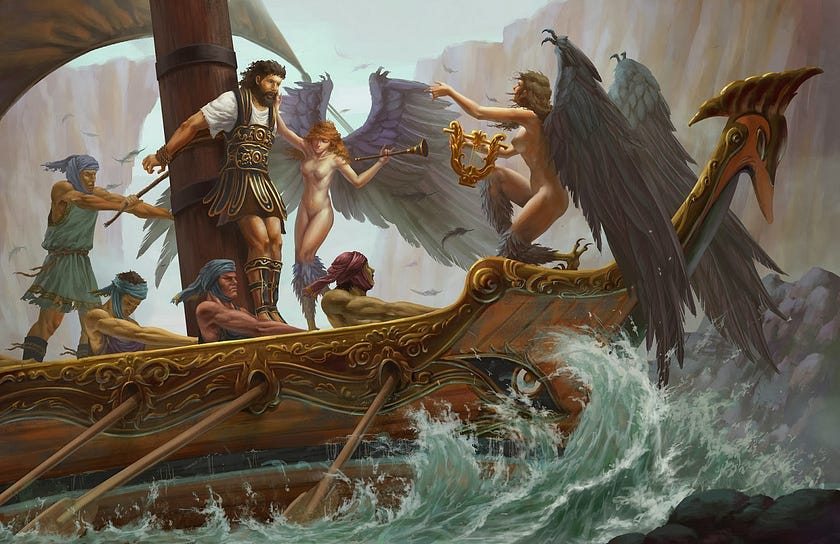
There’s a moment in Nolan’s Odyssey (sorry, I’m still obsessed) where Odysseus describes the Sirens’ song.
It told you what you most want is what you most can’t have. And what you most can’t have is what you already had…and lost…. It was the song of all promises I failed to keep.
I haven’t stopped thinking about this, because I’ve now heard the song too.
It doesn’t come from rocks off a coastline. It comes from a stage, from a product demo, from a voice saying “you’ll never have to struggle with this again”.
The machine’s pitch is a Sirens’ song in the strict Homeric sense: it sings to each listener in the voice of the thing they most want (mastery, time, relief) and the fee, collected quietly up front, is something you already had. The formed skill. The earned judgement. The self that the struggling built.
And like the song, the loss arrives as an itch you cannot reach.
The symptom
The man on the stage didn’t know what he gave away. And the terrible part I can’t shake, is that he can’t know.
Judging what you’ve lost requires the very faculty you lost. That’s the itch under the skin: you can feel that something is wrong, but the hand you’d scratch it with has been handed off.
The executive can no longer feel the questions his paper fails to provoke, because the capacity to generate those questions is what quietly went. A respected academic at the same dinner told me that he’s stopped writing papers because too many are machine-written and most of his colleagues use AI to review them (without guilt) anyway.
Maybe they’re right to feel guiltless. But the muscle of judgement will wither without use. So the confidence on that stage wasn’t evidence of mastery. It was a symptom.
That’s what I couldn’t place at first, why the boasting landed as something sadder than error. He wasn’t wrong about a trade. He’d forfeited the equipment needed to price it, and then stood up to teach the sin.
There’s a particular sorrow in watching someone celebrate, in public, at a podium, a loss they are structurally unable to perceive.
All skill is not your skill
Don’t get me wrong, I’m no saint on this. I use these tools every day. Maybe I’ve already been corrupted by them. They’ve made me faster and more ambitious about what I can take on. The people refusing them outright are making their own mistake, and it isn’t a small one.
AI lets you deploy expert skill. It does not let you deploy your skill - not unless you’ve done the long, unglamorous work of forming one first.
What the machine offers everyone, instantly, is general competence. But general competence was never what made anyone’s work worth keeping. What made it worth keeping was the shape of the person in it - the particular deformities of a skill hammered out through specific failures, specific obsessions, a specific life.
A kid from housing commission who learned to swim at 34 does not think about transformation the way the average of all writing about transformation thinks about it. That deviation (an accent, a scar) is the entire point.
The technology that hands everyone expert output is simultaneously dissolving the process by which anybody becomes somebody - because craft was never just how you made the thing.
Craft was how the thing made you.
The eulogy
Somewhere in the world right now, someone is using AI to write the eulogy for someone they loved very much.
And the machine will write a beautiful eulogy. Better structured than yours, more fluent than yours, packed with just the right kind of remembering.
And it would be made of dust.
Because a eulogy is not a text - the writing of it is the grief. The hours at the kitchen table, failing to find the words, is the honouring. The effort is not the means of production. The effort, the act, imbues the meaning.
Hand it to the machine and you don’t receive a more polished version of the act. You receive a beautifully formatted absence, the same way a machine-drafted apology is merely a fresh insult.
Some acts are like folding clothes: only the outcome matters, and automating them is pure gain, and I will not romanticise the folding. In fact, I fucking hate it.
But some acts are the other kind - acts where the doing is the entire thing, where the artefact left behind is just the residue of something that had to happen in you.
Writing that forces you to find out what you think. Judgement that costs you something to stand behind. The friction with the world through which your child slowly learns what another person is.
The executive and his simulated board, the academic and his guiltless reviews - the same single mistake, made in two different rooms. This will recur over and over and over again until we forget that it’s a loss.
The pride is what the misfiling will feel like from the inside. The loss won’t register, because the register will be the first thing to go. Arguments have opponents. This has volunteers.
So, a plea. Before you automate anything, don’t ask can the machine do this, because one day the answer will always be yes.
Ask: is the doing of this thing part of who I am becoming? If it is, do it yourself - badly, slowly, with your whole and only life
Odysseus lashed himself to the mast - not because the song was ugly, but because it was the most beautiful thing he would ever hear, and it was singing about everything he’d already lost. His crew sailed the same waters with wax in their ears - safe, and deaf to everything.
The song hasn’t changed. Will you be on the mast or on the rocks?
— Ashton