


In a previous newsletter I briefly mentioned my diagnostic tool - The Reinventor’s Mindset Index (“The Index”) and since then I’ve had a few people reach out wanting to learn more. How it works and why I built it.
For those of you who haven’t tried it yet, it’s completely free and available at the link below exclusively for all my newsletter subscribers. Feel free to have a play around and let me know what you think, your data remains private and secure.
Your Free Access to the Index is available here
How does the Index work?
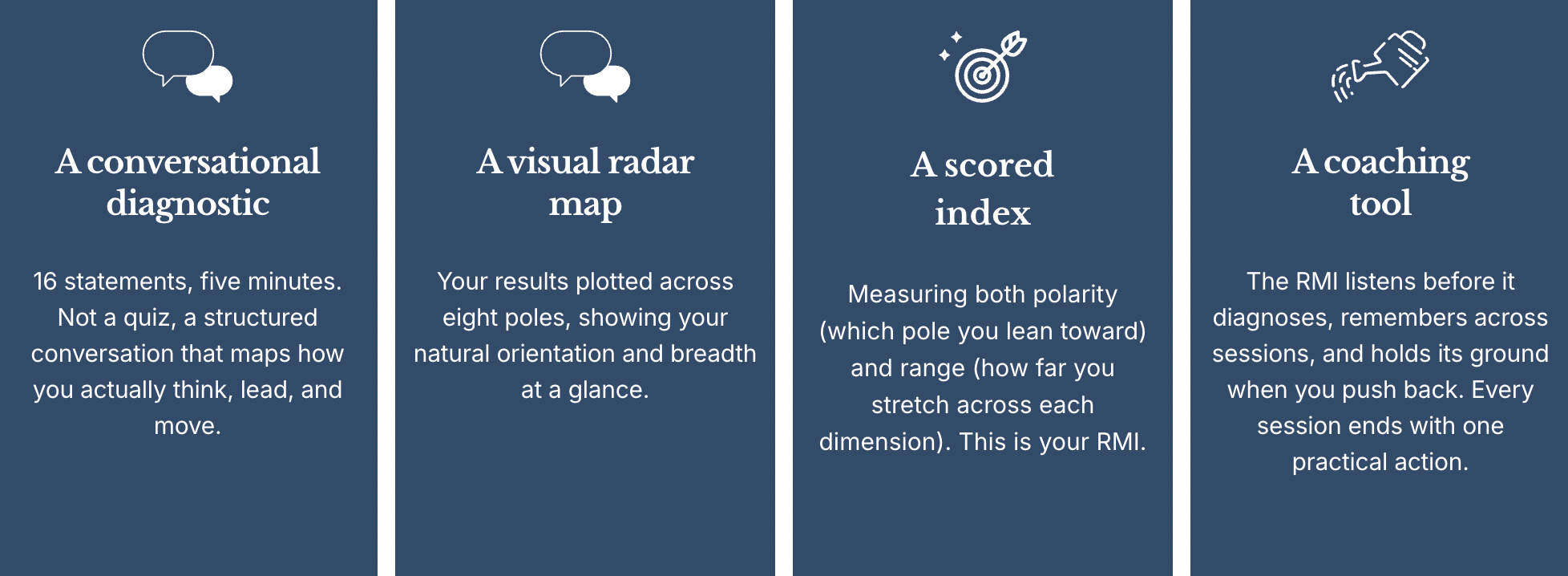
It’s sixteen questions and about five minutes. The login keeps your session memory so the tool remembers you between conversations but the stored data is de-identified, so it can't be traced back to you.
At the end it doesn’t hand you a score or a label. It hands you a shape: a radar that maps how you currently sit across the dimensions that drive reinvention. Less a test you pass or fail, more a mirror - it shows you the pattern you’re already running, including the parts you’d rather not look at.
Underneath it sits a validated psychometric model, not a personality quiz. And depending on where you’re starting from - founder, leader, or someone in the middle of a personal reinvention - the same questions get read back to you through a slightly different lens.
Why did I build the Index?
I developed the Index as part of an academic paper I am writing on AI safety and how you build cognitive guardrails into AI and agents. My hypothesis being that frontier LLMs are designed primarily to maximise user engagement and are quietly training us to outsource our thinking in counterproductive ways.
Ask a generic AI a question about yourself and it tends to give you the average answer - the smoothed-out, agreeable response that’s true of almost everyone and useful to almost no one. Left unguarded, a diagnostic built on a model like that would quietly tell everyone the same comforting story.
So the real work wasn’t the questions. It was the guardrails. I encoded a specific methodology and a validated psychometric model underneath the tool, so the AI has to stay inside the lines of something real instead of improvising its way to a nice-sounding answer. That constraint - building cognitive guardrails into AI and agents so they hold a standard rather than drift to the average - is what the paper is about.
How did I build the Index?
None of this was vibe-coded - though parts of it could have been. My secret weapon was Utkarsh Dubey - a Masters of Computer Science graduate who now runs his own tech shop called UTrix.
We built it together so I could learn the underlying platforms (Next.js, Clerk for sign-in, Supabase for storage, the Anthropic API) and he could learn the judgement required to improve the guardrails of the tool.
The part you can’t prompt your way to is the layer we built by hand - the coaching directives, the diagnostic logic, the judgement calls. That’s the difference between a diagnostic instrument and generic AI in a black box.
What is the Consciousness Revolution?
Near the end of Episode 5 of “The Reinventor’s Mindset” with Dr Corinna Galliano, the conversation turned to AI - and Corinna said something I haven’t stopped thinking about.
“If AI can get better than us at doing all these tasks, what’s left for us? It’s left to develop our consciousness and be more relevant than AI.”
She believes AI will force a consciousness revolution. Her logic is simple: if the machine gets better than us at the tasks, the only thing left to develop is the part of us the machine can’t reach.
I’ve been circling the same idea from the other direction. In markets there’s a concept called the flight to quality - when volatility spikes and uncertainty rises, capital moves to the highest-quality assets.
I think we’re about to see a flight to humanity. As average outputs get cheaper and more abundant, people will invest more in real experience, in judgment, in being genuinely in touch with themselves.
"As average outputs get cheaper and more abundant, people will invest more in real experience"
Fascinating piece!